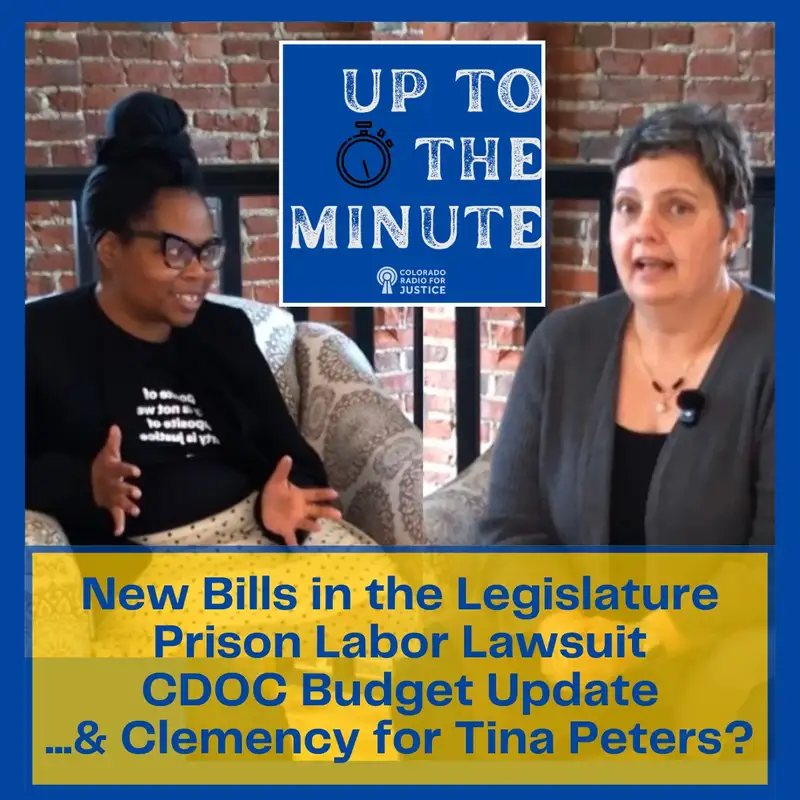
New Legi Bills; Prison Labor Lawsuit; CDOC Budget Update; & Clemency for Tina Peters?
UTTM 03-15-26 Joybelle Phelan Kym Ray Jennifer Dillon
===
[00:00:00]
Joybelle Phelan: ~You are listening to Up to the Minute. My guests today will be Kym from End Slavery, Colorado, and Jennifer from the Colorado Criminal Justice Reform Coalition. We're gonna be talking about a hodgepodge of things that are happening in the world right now. We are gonna talk a little bit about a lawsuit that is winding its way through the system and some bills that are wading their way through the legislature.~
~Right now in session, we're gonna start with Kym, who is with End Slavery, Colorado. You may have heard recently on the news that there was a lawsuit around slavery in Colorado prisons, and uh, I've heard a few questions. I'm sure you have heard a few questions. So what does the public need to know right now about all the questions that are swirling around?~
Kym Ray: ~Um, well I think like one of the biggest things that has, um, been coming up right is. Can we stop working now? Or My loved one has, um, gotten disciplined for not working. ~
Joybelle Phelan: ~I'm gonna stop you 'cause I didn't start that right. Okay. Sorry. We're gonna rewind. ~
Kym Ray: ~Yes. And you were ~
Joybelle Phelan: ~supposed to say, 'cause I gotta do a teaser for unlocking change.~
~Okay. Sorry. So I'm gotta stop you. Okay. We're gonna start over. Okay. I was gonna say something like, uh, we're gonna get more into that, more into the details of the lawsuit. ~
Kym Ray: ~Mm-hmm. ~
Joybelle Phelan: ~Today we're just gonna cover some highlights and some questions that are happening right now. Okay. Thank you. That helps me.~
~Okay. ~
Kym Ray: ~And thank you. 'cause I wanna re my answer. ~
Joybelle Phelan: ~Okay, great. Should I be using, do you want your last names in the recording or just your first name today? I am joined by Kym and Jennifer. Or do you want your whole name? ~
Jennifer Dillon: ~Name was fine, but I don't really ~
Joybelle Phelan: ~care. Okay. Do you have a preference? I'm ~
Kym Ray: ~comfortable with just Kym.~
Joybelle Phelan: ~Okay, great. I think ~
Kym Ray: ~I've been on the show. ~
Joybelle Phelan: ~Well, if we're gonna do just Kym, then we're gonna do just Kym and just Jennifer so that it flows. And it's Jennifer. You don't want to be Jen. Correct. Okay. That's what I thought. ~
Kym Ray: ~Okay. ~
Joybelle Phelan: ~I always have to ask just in case. Okay. Okay.~ Hello and
Intro
---
Joybelle Phelan: welcome to Colorado Radio for Justice.
I'm your host, Joybelle Phelan, and today on Up To the Minute, I'm joined by Kym from End Slavery, Colorado, and Jennifer from the Colorado Criminal Justice Reform Coalition, and we're gonna be talking about several things. We're gonna start with Kym, who is with End Slavery Colorado. There has recently been a lawsuit around ending slavery in Colorado prisons.
We're gonna dig much more deeply into that on our upcoming [00:01:00] issue of. Unlocking change. Today we're just gonna cover some highlights and some questions that we're seeing in the media and we're getting a lot of on social media and in the neighborhood. Let's start with, so there has been a lawsuit. Um, we're not gonna get deep into it because it is potentially going to be appealed, but what is the high level?
What happened and what questions are you really getting a lot of on social media right now?
The Lawsuit: What Happened?
---
Kym Ray: Absolutely. So, um. Back in 2022, um, there was a lawsuit that was filed, um, and has since turned into a class action lawsuit. And back in February, the judge ruled, um, that, well anyone expressed some disappointment around the lack of change, um, since Amendment A in 2018, the ballot measure that changed the language of our Colorado constitution, um, and then also emphasized that.
There, um, ruled that [00:02:00] there was involuntary servitude, in fact happening inside of the Department of Corrections, that people around coercion and that people were being forced to work. Okay. And that this should stop.
Joybelle Phelan: So while we were chatting before the show, you said that a lot of people are hearing, um, what happens.
So the, the judge has made this ruling. What happens right now?
What Happens Now?
---
Kym Ray: ~Okay, so right now, um,~ essentially the impact for the people that are currently living in prison, nothing. Um, there is a window, she left a window of 28 days for the opportunity for there to be appeals. Um, so that means in, in that span of those 28 days, um.
Things are still business as usual. So folks should definitely still go to work to their work assignments. Um, and because if not there, there will be, you know, could be consequences. Mm-hmm. And most likely will be consequences because right this second, nothing [00:03:00] has changed. Okay.
Joybelle Phelan: Because the appeal, there's still that 28 day window where they could appeal.
And so until that happens. No policies have changed.
Kym Ray: No policies have changed.
Joybelle Phelan: ~Okay. ~
Kym Ray: ~Exactly. ~
Joybelle Phelan: ~So you also mentioned that another question you're getting, um, is ~
Class Action
---
Joybelle Phelan: you mentioned very briefly it was a class action lawsuit.
Kym Ray: Mm-hmm.
Joybelle Phelan: And you're people are asking, can we join the lawsuit? How does that work?
Kym Ray: ~Yes. Um,~ the short answer is no, you can't go, you can't join the lawsuit.
Unfortunately, if you've been to prison and now you're home, um, there, there's no compensation. Um, and in fact. believe it or not, this lawsuit was not about monetary compensation, so to be honest, the whole premise was to stop forced labor. And meaning stop punishing people for not working, for be it, choosing not to, not being sick and not able to, those sorts of things.
And so that was the goal of the lawsuit, was [00:04:00] to realize amendment A and to actually have, um, there to be in Colorado, no slavery and no involuntary ancy.
Joybelle Phelan: So you're telling me. So when I was in prison way back in 2012, I got a failure to work writeup because I was out to court. You're telling me I can't join the lawsuit,
Kym Ray: unfortunately, no.
Joybelle Phelan: Darn
Kym Ray: no lawsuit.
Joybelle Phelan: And it's not about money. So essentially what I hear you saying, and I don't wanna put words in your mouth, but the way I'm interpreting it as what we're trying to do with this lawsuit is. Provide, provide the same level of agency to folks who are currently residing in prison that you or I might have about going to work tomorrow?
Kym Ray: Exactly.
Providing People Autonomy
---
Kym Ray: We want people to have some autonomy. Right. Um, but of course, just like you and I out here, you know, if we choose to say, I'm not going to [00:05:00] work today. Right? Granted, we may have sick leave or whatever, but there may be a consequence if you don't have enough sick time, you don't get paid. Mm-hmm.
Right?
Joybelle Phelan: Right.
Kym Ray: Um, so the thing is, is focus on the inside. If they make the choice. Not to work even in the best case scenario, right? DOC does not appeal. The governor's office does not appeal. Um, there could still be consequences. Um, very, you know, that. May not be, um, restrictive housing or solitary sort of conditions, but there will be, you know, with choice comes consequence.
Joybelle Phelan: Right. And I think like that's important to know no matter where you are.
Kym Ray: Exactly.
Joybelle Phelan: ~Okay. Is there anything else about that topic you feel like we should cover right now that we will not be covering in unlocking change? ~
Kym Ray: ~Um, I think that's the, you know, ~
What Incarcerated Listeners Should Know Today About Work Assignments
---
Kym Ray: the biggest thing is, um, we wanna make sure that folks know that in this moment, go to work, go to your work assignment, go to your, your classes, do the things, [00:06:00] um.
And that, you know, this lawsuit is just the beginning.
Joybelle Phelan: Mm.
Kym Ray: Right. Um, court cases do not implement themselves. Um, the coalition we want to work with Department of Corrections. We want to work with Governor Polis with the governor to, um, reimagine what could be - we are, I believe in a really great space of opportunity.
Joybelle Phelan: Mm.
Kym Ray: Right. We can be the first, we can. Colorado's been trailblazing on so many things that we could actually be the first to really, really reimagine what work and what labor can be. How do we spend this from punitive to incentivizing? we're in a space to reimagine something new.
Creating an Opportunity
---
Joybelle Phelan: So even though it's a lawsuit, which I know when I hear the word lawsuit, I think like adversarial, like a divorce case where people are, you know, beating each other's heads because they wanna win. Sounds [00:07:00] very much like what you are saying here is this isn't, um, an adversarial sort of thing that this is an opportunity for stakeholders to come in and have a conversation around.
What else could be here?
Kym Ray: Exactly, exactly. The coalition has never seen this as a, and even the attorneys have never seen this as like, we're duking it out. Right. Um, but more so like, how do we come together? And I think, again, there's opportunity for collaboration. I love
Joybelle Phelan: that. Well, like we've been teasing, we're gonna dig a lot more into this issue~ in the next issue,~ in the next episode of Unlocking Change.
Today has just been a high level overview. Kym, with End Slavery Colorado, thank you so much for joining me today.
Jennifer Dillon: Thank you.
Joybelle Phelan: ~Pause. Welcome back to Colorado Radio for Justice. I'm your host today, joy Bell Falin, and we're on up to the minute. ~
Jennifer Dillon: CCJRC
---
Joybelle Phelan: Joining us now is Jennifer with the Colorado Criminal Justice Reform Coalition.
We're about halfway through the legislative session right now. Some interesting things are happening. We're gonna talk about several different bills that are moving or not moving through the session and talk about sort of what that [00:08:00] means.
Prison Beds
---
Joybelle Phelan: Let's start with prison beds. You guys have heard on a previous issue episode of up to the minute that the Department of Corrections asked for funding for 941 beds.
The joint budget committee. First they said no. Then they said yes, and now.
Jennifer Dillon: They said no again. So the first no. And then yes, was part of what's called the supplemental budget request. That's for the current year that we're living in. DOC came back at the, comes back at the beginning of the year. Most departments do and say, Hey, uh, we don't have enough money to finish out the year, so we need some extra things.
Um, so the. JBC, the Joint Budget Committee who determines whether they give money to all these state departments, first looked at it and said, you haven't done enough to, uh, manage the, the bottlenecks on the release side, so we're gonna withhold funding for those beds. Couple days later, they came [00:09:00] back and said, okay, we understand that this is a serious problem and you need those beds right away.
We're gonna go ahead and give you the funding, but. Later this session, we're gonna start talking about the next fiscal year, which is 20 26, 27 fiscal year budget. And if you don't come back with a plan, a comprehensive plan to manage your bottlenecks and manage that prison population, we're not gonna fund those beds.
So that was kind of the threat. Right. Okay. Um, and now we're seeing that threat.
Joybelle Phelan: This is the result of that.
Jennifer Dillon: This is the result. So now they're in that second budget phase.
Joybelle Phelan: Okay?
Jennifer Dillon: And, uh, DOC came back to the table and said, Hey, we, those beds you gave us for this year, we wanna keep 'em for next year. And JBC said, we don't see a plan yet.
We're hopeful. They said they're optimistic.
Joybelle Phelan: Okay?
Jennifer Dillon: Um, that talks were happening, but they still hadn't seen that plan yet. And we think it's kind of, you know, a [00:10:00] pressure point to kind of keep DOC at the table, um, working on that plan so they don't just like abandon that effort. Right. So they just wanna see that plan.
Uh, so they did deny the beds for funding those 941 beds for next year. Um, DOC will now have an opportunity to come back, talk more about it, obviously work on the plan. Mm-hmm. Right. That they can then, you know bring to the JBC and, and in hopes that the JBC will change their mind.
What If the State JBC Says a Final "No" to New Prison Beds?
---
Joybelle Phelan: Is there a world in which the JBC says, Nope, we don't like your plan, we're not gonna give you the funding for those beds.
Like, is that a real possibility?
Jennifer Dillon: Um, I would be very shocked by that, but I guess it is a possibility because, um, you know. The, the DOC has definitely been at the table, um, talking to, um, to folks about plans that, the things that they could do to manage. Okay.
Joybelle Phelan: Alright.
Jennifer Dillon: So, um,
Joybelle Phelan: you [00:11:00] feel pretty optimistic
Jennifer Dillon: that a forum, so for whatever, whatever reason, reason this JBC leverage it, it is some leverage.
It's working.
Joybelle Phelan: They have, apparently.
Jennifer Dillon: Hopefully.
Joybelle Phelan: ~Okay. 'cause you did, 'cause I think you said the committee voted four to two, so the first time. It was five to one, right? Like only one person said ~
Jennifer Dillon: ~No, it was Oh. Oh. I think it was Al always. ~The two Republicans have been voting yes to fund. Um, I think, I think it was four to two left.
I mean, might have been three. Three even three to three is a no.
Joybelle Phelan: Right. Oh, okay.
Jennifer Dillon: Um, yeah, they need to have a majority.
Joybelle Phelan: Okay. That's interesting.
Jennifer Dillon: Yeah.
Joybelle Phelan: So we'll see what happens. Yeah. So are we at the point where figure setting has started? They need, this
State Budget Figure Setting Is Underway
---
Jennifer Dillon: is the figure setting process for next year.
Joybelle Phelan: Okay.
Jennifer Dillon: So they're in that process.
Joybelle Phelan: Is there a deadline by which they have to have this decided by?
Jennifer Dillon: There is a certain deadline, I don't remember what it is, when they ha, when the JBC has to have introduced their bills for all the fund, for the funding, for all the state departments. To the legislature to vote on.
Joybelle Phelan: Okay.
Jennifer Dillon: Yeah. Um, I don't, that is coming up, but it's not here yet.
Joybelle Phelan: Okay. So
Jennifer Dillon: they [00:12:00] just started, like the first week of March is when they started the bigger setting process. So they have a couple of weeks,
Joybelle Phelan: so this will probably move again in the next few weeks
Jennifer Dillon: probably.
Joybelle Phelan: Okay, well, we'll stay tuned for that. Yeah,
Jennifer Dillon: it's drama.
Joybelle Phelan: It isn't it always.
Tina Peters' Prospect of Clemency
---
Joybelle Phelan: The other thing that's been a lot in the news lately is Tina Peters Oh, sure.
And potentially clemency.
Jennifer Dillon: Yeah. Interesting.
Joybelle Phelan: It is interesting. Um, and so I'm, I'm wondering, you know, as I know a lot of people, I have several friends that left prison thanks to clemency. Right. I have many more friends. Who are anxiously either waiting to hear or Yeah, applying.
Jennifer Dillon: Yeah, sure.
Joybelle Phelan: And it's interesting we're talking about Tina Peters.
Um, it's been on the news, several news channels recently and what's interesting, and I think of several, like I think Kyle with CC JRC has also noted. Tina Peters has never expressed any level of remorse.
Jennifer Dillon: That's true.
Joybelle Phelan: Does not agree that she did anything wrong. True. Right. Um, president Trump has given her a [00:13:00] federal pardon, which does not automatically translate to the state.
Jennifer Dillon: It doesn't at all.
Joybelle Phelan: Right? It's not fully different things. Yeah.
Jennifer Dillon: He can't pardon her because she was not a federal prisoner.
Joybelle Phelan: Right. And so it's interesting. So the governor, governor Polis has said he is considering Yes. Granting her clemency. I don't even know that she's applied.
Jennifer Dillon: No. Well, her lawyers have said that she has that they've submitted some things to,
Joybelle Phelan: okay.
Jennifer Dillon: Uh, governor Polis,
Joybelle Phelan: I don't. Is that how the clemency process works? Don't,
Jennifer Dillon: I don't believe that it's gone through the clemency, the governor's own clemency board that he set up, um. Which looks at the, looks at cases where people have applied for clemency and then makes recommendations to the governor, and then he's supposed the next step is he's supposed to then look at those recommendations and, uh, decide based on what that board has recommended.
[00:14:00] This seems to be, even though that that system, we don't know who's been recommended, but it seems to be like she's jumping over, would be jumping over that process.
Joybelle Phelan: Well, 'cause I think. Isn't, I haven't looked at the, the statute, but don't, doesn't someone have to serve like 20 years of their sentence before they can apply for clemency?
Jennifer Dillon: I don't know if that's always the case.
Joybelle Phelan: Okay.
Jennifer Dillon: Alright. That's interesting. Um, but I do know that, um, governor Polis in previous years, you know, he gets these recommendations from his clemency board. He's tended to grant about 20, like low 20. 20 some people.
Joybelle Phelan: Mm-hmm.
Jennifer Dillon: Uh, clemency every year, except last year he still hasn't worked.
You know, he says he needs more time to work through the recommendations that his advisory board made.
Joybelle Phelan: Mm-hmm.
Jennifer Dillon: So he didn't even offer anyone clemency last year mm-hmm. Who applied. Uh, it seems [00:15:00] wild that this year he would, having not worked through that backlog at all, uh, would now be offering this, you know.
A person who's like, well collect, connected politically who has not expressed remorse, et cetera. Um, considering to grant her clemency, that feels like there's two systems of justice, you know? Mm-hmm. Somebody for somebody. Who's well connected, um, and high profile versus kind of everyone else.
Joybelle Phelan: True. And it, I'm, I think I heard on the news that one of the reasons Governor Polis is looking at her is due to her age and yet.
Special Needs Parole List
---
Joybelle Phelan: What about the people that are on the special needs parole list?
Jennifer Dillon: Yeah, so interesting. Like, uh, there's so few people who have been released on special needs parole. Mm-hmm. People who, like, people who have
Joybelle Phelan: cancer
Jennifer Dillon: hospice care.
Joybelle Phelan: Mm-hmm. Yeah.
Jennifer Dillon: You know, Peter's certainly not [00:16:00] there.
Joybelle Phelan: Doesn't seem like it.
Jennifer Dillon: No.
Joybelle Phelan: Right.
So it's just interesting. Um, it'll be interesting to sort of look through and see. Um, how that works. Yeah. Because it's, um, do you have a sense why is this becoming such a flashpoint right now? Is it just because it's the end of the governor's term?
Jennifer Dillon: Well, I think, uh, in terms of the people who are like throwing up their hands, being like, why are you doing this?
I think the big concern is that it's happening before the November election.
Joybelle Phelan: Mm.
Jennifer Dillon: And it kind, you know, it could send a signal to folks. You know, if you want to interfere in Colorado's elections, don't worry about it. It's okay. Like, there's that kind of fear mm-hmm. Coming into the election, you know? Um, that's, I think that's making this, this a bigger deal than it would be maybe at other other point.
Joybelle Phelan: Mm-hmm. Yeah. And she's been on the news just so much.
Jennifer Dillon: Yeah.
Joybelle Phelan: ~Yeah. We'll wait for you to walk through. Kyle. We're editing you out, Kyle. We got you buddy. ~
Joybelle Phelan: [00:17:00] ~Let's move on to the um, Senate bill 26 0 99. No, that's not the one you want. 'cause that's the, that's that's the one. Because this is the one you know more.~
~Right. ~
Jennifer Dillon: ~So this is the one you wanna talk more about ~
Joybelle Phelan: ~first? Oh yeah, sure. Okay. ~
House Bill 261017
---
Joybelle Phelan: So let's talk about House bill 26 1 0 1 7. That's the criminal restitution for insurers Bill.
Jennifer Dillon: Yeah,
Joybelle Phelan: Kyle talked about that a little bit the last time he was on Up to the minute.
Jennifer Dillon: Yeah.
Joybelle Phelan: What are the updates about that now?
Jennifer Dillon: So it's moving really well through the legislature.
It passed in the house and then just this week, uh, it passed through the Senate judiciary. It's going to the Senate floor. If it passes there, then it goes to the governor's desk. So that one's moving pretty along pretty steadily. And, uh, we're hopeful. And that's one of CC JRCs primary bills this year, uh, that we're working on.
Joybelle Phelan: So is there any very
Jennifer Dillon: exciting,
Joybelle Phelan: is there anything. People at home need to do to help support that one. Are we sort of, once it's in committee and going to the floor, there's not so much folks at home can do.
Jennifer Dillon: Well, no, that's, that's never true. Like, especially legislatures, legislators wanna hear from people who, who have been per, who have lived experience with this issue.
Right? So anybody out [00:18:00] there who ha is paying criminal restitution to an insurance company. Right. You're, if you have a senator, you have a senator in the state of Colorado, uh, definitely give them, send them an email and tell 'em how it's been.
Joybelle Phelan: Okay.
Jennifer Dillon: Yeah. Great. 'cause this is gonna move to the Senate floor for votes and people and those folks wanna hear from their constituents that this is an actual problem that needs to be solved.
Joybelle Phelan: Okay, great.
Jennifer Dillon: Yeah.
Joybelle Phelan: Cool.
Jennifer Dillon: That's fantastic that, that's moving right on through. Yeah.
House Bill 261281
---
Joybelle Phelan: So another one I wanted to talk about today that was interesting to me is, so there is a house Bill 26 12 81. Which is about homicide criminal offenses. Right now, the bill is, from what I understand from reading it, the exact term is called Extreme indifference murder.
This bill is narrowing what can be classified
Jennifer Dillon: as extreme. Is that, yeah, so I think the problem that the legislators who are bringing this bill are trying to solve basically is that, um, there's [00:19:00] something called extreme indifference to human life that can. Um, if you, if a human life is taken, that can be charged with as first degree murder, even if there's not like premeditation, right?
Mm-hmm. So, um, I think they feel like it's be maybe being applied too broadly in Colorado and that it's not well defined what extreme indifference is. So this bill is taking, is an, is making an attempt to kind of put the parameters around that a little bit better. Define it a little bit better so it's not so broadly applied.
Joybelle Phelan: So one of the examples they talked about is that, um, it'll create two new crimes or new felonies, one of which being aggravated vehicular homicide. Right. Both of the new crimes that it creates are related to vehicular homicide. Yeah. So like, just on the surface that sort of leads me to believe that we're talking about potentially, um, somebody was in a car [00:20:00] chase.
Hit a pedestrian. And so in the past they would've been charged with first degree murder.
Jennifer Dillon: They could have been Correct.
Joybelle Phelan: So the what this bill is trying to accomplish is instead of that
Jennifer Dillon: Yes.
Joybelle Phelan: And that the sentence that comes with that,
Jennifer Dillon: yeah.
Joybelle Phelan: We don't already have vehicular homicide.
Jennifer Dillon: We do, but this would probably be a higher penalty.
Mm. Um, not quite first degree level. First degree murder level penalty, but not quite the lower level.
Joybelle Phelan: A vehicular homicide. And so the way that could potentially change how prosecutors are charging cases is that it gives, gives them a little more decision making in a case like that.
Jennifer Dillon: Well, I think it gives them parameter better parameters for deciding, um.
How this extreme indifference to human life is interpreted. Okay. Yeah.
Joybelle Phelan: All right. And this is a bill that C-C-J-R-C is supporting.
Jennifer Dillon: Uh, we do support it. We're not involved in it [00:21:00] in any way. Um, but, but on
Joybelle Phelan: the face of it, you're
Jennifer Dillon: not the face of, but not seeing
Joybelle Phelan: anything
Jennifer Dillon: face of it. It seems like a positive change
Joybelle Phelan: to us.
Okay, great. That's good to know.
Jennifer Dillon: As
Joybelle Phelan: the voting public, that's important to know.
Jennifer Dillon: Yeah.
Joybelle Phelan: There's another bill that is currently moving through that was really interesting to me.
Senate Bill 26099
---
Joybelle Phelan: Um, so it is Senate Bill 26 0 99. Oh
Jennifer Dillon: yeah.
Joybelle Phelan: Which is the temporary classification of controlled substances.
Jennifer Dillon: Yes.
Joybelle Phelan: Now, what this bill would do potentially is it would allow the governor.
To temporary classify substances as a schedule two controlled substance analog.
Jennifer Dillon: Yeah.
Joybelle Phelan: By executive order.
Jennifer Dillon: Right.
Joybelle Phelan: So let's start with what happens right now.
Jennifer Dillon: Well, right now, um, things have to be, things are classified as a schedule two drug by, by a different process. Right. And
Joybelle Phelan: like the,
Jennifer Dillon: the federal process.
Joybelle Phelan: Yeah. Like the FDA sort of process.
Jennifer Dillon: Right. Exactly. Right, right, right. So, [00:22:00] um. So governors can't just say, Hey, thi this, thi this thing that just popped up. We're gonna call that a schedule two drug. They don't have that power.
Joybelle Phelan: But what this bill would do would be to give the governor that power. Yes. Stay at a state.
So even if the federal government said, whatever,
Jennifer Dillon: yeah,
Joybelle Phelan: this drug is a schedule two here in Colorado. Or let, I don't know the levels. So if the federal government said, oh, this drug is,
Jennifer Dillon: or they just haven't seen it
Joybelle Phelan: yet, it's
Jennifer Dillon: not on
Joybelle Phelan: their radar screen, or they,
Jennifer Dillon: it's
Joybelle Phelan: moving through the process. Here in Colorado, a governor could, a governor could sign an executive order that says this particular drug, this particular is a schedule.
Jennifer Dillon: Yes.
Joybelle Phelan: Like, why would the lawmakers be considering that?
Jennifer Dillon: Well, I'm, I'm sure the concern is that, um, because the street drug supply is, is more volatile now than it has ever been.
Joybelle Phelan: Mm-hmm.
Jennifer Dillon: Um, that new things [00:23:00] could pop up and be causing harm in our communities and they would have to wait. Right before
Joybelle Phelan: however long the federal government takes to classify it.
Jennifer Dillon: Yeah. Or however long that classification process happens. Um, but we haven't, um, in, we haven't seen, seen that come up yet where something's come into our state and we didn't have a schedule two, right? Mm-hmm. So it's all, I don't know if, I don't know. The extent to which it is a problem.
Joybelle Phelan: Mm-hmm.
Jennifer Dillon: Maybe it's, uh, proactive,
Joybelle Phelan: maybe.
So we were talking before the show as we were preparing and you said what's interesting about this bill is that it's not moving.
Jennifer Dillon: Yeah.
Joybelle Phelan: What does that mean?
Jennifer Dillon: Yeah, so a lot of, so legislators at the beginning of a session, they can pull a certain number of bill titles. They do. Um, and not all of them necessarily go through the process, right?
So, um, this bill was introduced with just one [00:24:00] sponsor, usually bills. If someone's, if, so, if a legislator is really working it, um, they will ha at least have a sponsor from the other house. So, for example, this bill is brought by Senator Barbara Kirkmeyer, who is running for governor. So in theory, she would be, uh.
Creating a law that would've been, would allow her as governor to sign executive orders like this.
Joybelle Phelan: But isn't that a conflict of interest?
Jennifer Dillon: It's interesting. Okay. For sure. It's interesting.
Joybelle Phelan: Okay.
Jennifer Dillon: But she doesn't have a co-sponsor in the house, so that means there's no one in the house to like whip votes for it, bring it to committee, like, uh, run it through the process.
So, um. It kind of indicates like a lack of seriousness
Joybelle Phelan: or like a lack of, like a lack of bipartisan support sort of.
Jennifer Dillon: Well, it doesn't have to be bipartisan. You can, she's, so Barbara Kirkmeyer is a Republican senator. She could have a Republican House member as a [00:25:00] co-sponsor, and that person would be responsible for running it through.
Joybelle Phelan: But, but typical. But typically you see Bills that have both a sponsor in the Senate and the house.
Jennifer Dillon: Exactly.
Joybelle Phelan: They're the ones that come to conclusion.
Jennifer Dillon: Oh yeah, for sure.
Joybelle Phelan: Okay.
Jennifer Dillon: Yeah,
Joybelle Phelan: so interesting. So I noticed, so supporters would say that this bill helps respond quickly to new synthetic drugs. I think that's.
So theoretically.
Jennifer Dillon: Yeah.
Joybelle Phelan: Right. We don't know.
Jennifer Dillon: Yeah.
Joybelle Phelan: Critics I think would worry about expanding executive power.
Jennifer Dillon: Yeah.
Joybelle Phelan: Right.
Jennifer Dillon: Yeah.
Joybelle Phelan: So how do you feel like lawmakers might be debating this? I mean, we know it sounds like it's not gonna move forward. At least as of right now.
Jennifer Dillon: I, there's still times she could all.
Senator Kirkmeyer could always get a cos a co spon house sponsor and then, and then bring it to committee and start working through the process. Of course, the longer you wait, uh, the, a lot of bills die on the table towards the end of session. '
Joybelle Phelan: cause they haven't
Jennifer Dillon: had time to, 'cause they didn't have enough time to go through the process.
Joybelle Phelan: Okay.
Jennifer Dillon: Um, but it's, it's always possible. [00:26:00] Um, we haven't heard, because it hasn't gone to committee yet. We haven't heard the arguments on both sides. Okay. Um, about what people's concerns would be. But, um, suffice to say in our, in, we are opposing the bill 'cause we, on the surface of it, uh, seems like a solution looking for a problem.
Joybelle Phelan: Mm. And there's always the question like, as a voter, right? Like paying attention to what sort of executive power are we giving? Our officials.
Jennifer Dillon: True.
Joybelle Phelan: Right. So that's something to think about.
Jennifer Dillon: Yeah.
Joybelle Phelan: Well, is there anything today especially that you wanted to talk about or that I as a question maybe that I haven't asked, that you feel it's important for our listeners to pay attention to?
Jennifer Dillon: Well,
CCJRC's Weekly Legislative Updates
---
Jennifer Dillon: I do want to let your listeners know that we do a complete legislative update every week, uh, that we send out to folks on our subscription list. So if you go to cc jrc.org, if you're a policy nerd about criminal legal policy [00:27:00] and you wanna know how these bills are moving through the legislature, uh, we do a weekly update to keep everyone informed and let, the key thing is that, you know, opportunities where.
Bills all of a sudden need to hear from, to in order to pass or to fail, they need public pressure.
Joybelle Phelan: Mm-hmm.
Jennifer Dillon: Um, we kind of keep on top of that, you know, for those kind of criminal legal reforms. So, um, if you subscribe to the newsletter, we can send out, send it out to you and say, Hey, uh, everybody contact your senator right now on, if you're contact the Senate judiciary, there's a bill in.
In committee this week. That's really important. And they need to hear from a bunch of people. That's how, um, that's how change are made actually.
Joybelle Phelan: Okay.
Jennifer Dillon: Yeah, it's important.
Joybelle Phelan: That's good to know. So they can go to ccrc.org?
Jennifer Dillon: Yep. Subscribe to our newsletter.
Joybelle Phelan: Okay, great.
Jennifer Dillon: And then, uh, you'll get those updates.
Joybelle Phelan: ~So I thought of something while you were talking that I don't, we didn't, I didn't prep, I did not prepare you for this at all, so we might not talk about it.~
~It's ~
Jennifer Dillon: ~okay. ~
Joybelle Phelan: ~But, um, someone I know mentioned something about, there was something happening today around communication bill. Something around. Um, so Colorado is on the track right now where phone calls from the state prison system eventually will not cost. They're moving toward free communicate. Oh. I was like, it's gonna take a few years.~
Jennifer Dillon: ~Yeah. ~
Joybelle Phelan: ~And somebody had asked me, well, are you gonna be, are you gonna be there to testify on this thing tomorrow? And I was like, I don't What thing? I don't even know what you're talking about. ~
Jennifer Dillon: ~I didn't know that was moved through the legislature at all. ~
Joybelle Phelan: ~Okay. So we're gonna have to do some research.~ So, well, so that is.
All we have for you today on [00:28:00] Up to the Minute thank you to Jennifer from the Colorado Criminal Justice Reform Coalition, and I am You've been your host, Joybelle Phelan. You are listening to Colorado Radio for Justice.